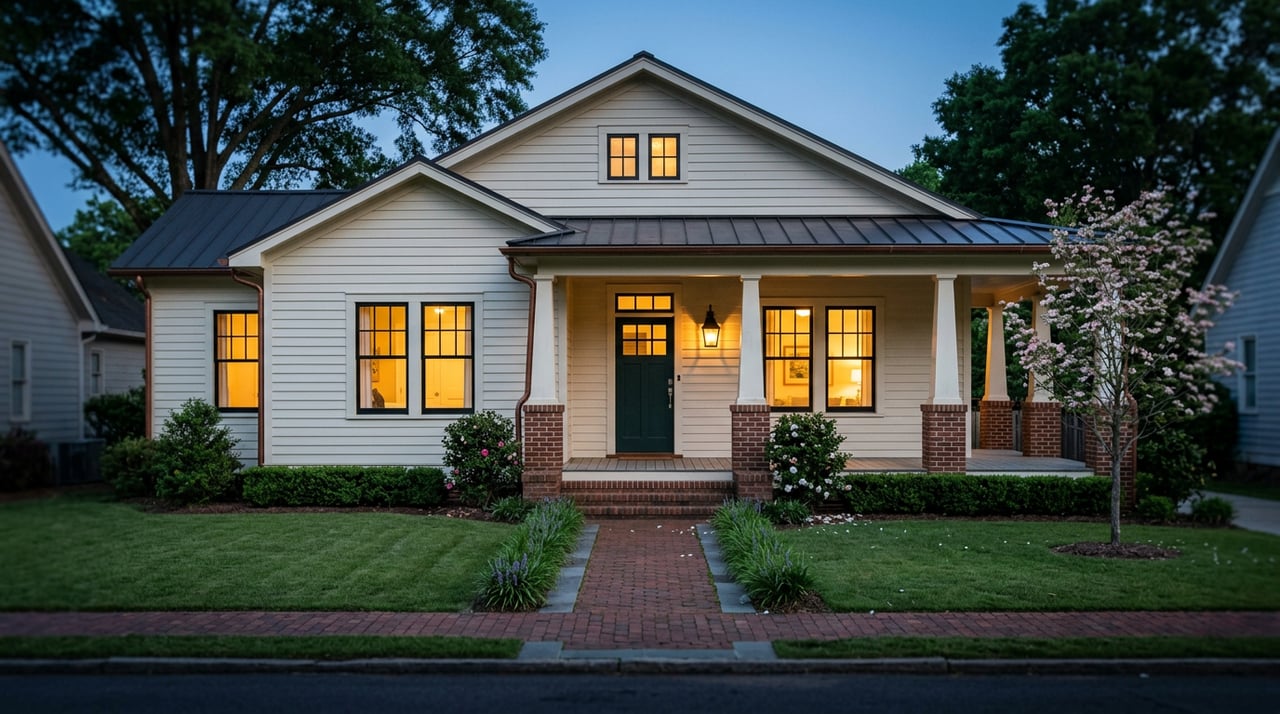
Ask most buyers what a National Register listing means for a Virginia-Highland bungalow and you'll hear some version of "protected." That's the wrong word. Virginia-Highland has carried its National Register of Historic Places designation since 2005, and the Georgia Department of Community Affairs says that listing opens the door to Georgia's historic rehabilitation tax credit. The Georgia Department of Community Affairs says National Register listing places no restrictions on an owner's use or treatment of private property. A National Register listing records what a house is. It does not decide what an owner is allowed to do to it next.
According to the Virginia–Highland article on Wikipedia, enforceable historic-overlay protection exists in exactly one pocket of the neighborhood: Atkins Park. Everywhere else in Virginia-Highland, from the Craftsman blocks along North Highland to the Tudor Revival stretch of St. Charles Avenue, an owner who wants to tear down and rebuild is working from a much looser rulebook. Understanding where that rulebook actually applies, and what fills the gap where it doesn't, tells you more about how this market prices a bungalow than the historic label ever will.
What the National Register Actually Locks In
A National Register listing is a description, not a permit system. It documents architectural significance. Georgia's 25 percent state credit for qualifying certified rehabilitation can be a real financial incentive. What it does not include is a demolition review process. An owner inside a National Register district who wants to replace a house entirely faces the same permitting path as an owner anywhere else in the city, provided no separate local overlay applies to that specific parcel.
That distinction matters because Virginia-Highland's own civic association has drawn the same line. The neighborhood's preservation committee has, in its own words, looked at extending enforceable historic overlay protection across the wider neighborhood the way it already exists in Atkins Park. That expansion hasn't happened. For now, the enforcement layer is geographically narrow, even though the National Register label reads as neighborhood-wide.
The One Pocket With Real Teeth
Atkins Park sits inside Virginia-Highland's boundaries but is recognized by the city as its own neighborhood, and it carries something the rest of VaHi doesn't: a local historic overlay district with actual enforcement authority through the Atlanta Urban Design Commission. Inside that overlay, exterior work and demolition can trigger historic review under the Atlanta Land Development Code.
Outside that overlay, in the rest of Virginia-Highland, the review process is different. The gap isn't subtle: a homeowner two blocks inside Atkins Park and a homeowner two blocks outside it, on visually identical 1920s bungalows, can face different processes for exterior work.
What Fills the Gap Everywhere Else
If formal review isn't doing the work outside Atkins Park, something else is, and it's worth naming because it explains why teardowns in Virginia-Highland are still rare rather than routine.
The first constraint is physical. Most VaHi lots were originally platted around 50 feet by 125 to 200 feet, a footprint that limits what a teardown-rebuild can actually deliver in square footage without variances, and variances invite the kind of neighborhood scrutiny that slows a project even without a formal overlay behind it.
The second is zoning itself. The Virginia-Highland Civic Association says most of the neighborhood sits under R-4 single-family or RG-2 low-density multifamily designations, and the city's own 2018 master plan update for the neighborhood documented years of community input about maintaining existing single-family zoning, particularly around the Monroe Drive and Cresthill intersection, an area discussed in connection with redevelopment.
Put together, the picture is less "protected historic district" and more "a neighborhood where lot size, the zoning category, and the particulars of each project shape how projects unfold." That's a very different risk profile than "historic district," and it's the one buyers should actually be pricing.
What That Split Costs, and Creates, in the Market
The neighborhood's price tiers track this split closely. As of early 2026, here's roughly how Virginia-Highland's housing stock breaks out by condition:
| Home Type | Typical Price Range |
|---|---|
| Unrenovated original bungalow | $700K to $1M |
| Renovated Craftsman | $1.1M to $2M |
| New construction or teardown-rebuild | Starts above $2M, exceeding $3M in premium pockets |
| Condo or townhome | $500K to $800K |
The median sale price for a single-family home in the neighborhood ran around $1.1 million in early 2026, with steady long-term appreciation closer to 5 to 7 percent annually over the past five years. That teardown-rebuild tier at the top isn't just a premium finish level. Its scarcity is greater than the neighborhood's historic-district reputation implies, and the price reflects it.
Where the Real Development Pressure Is Landing
The bigger money isn't chasing interior bungalow blocks at all. It's landing at the edges where zoning is already more flexible. Portman's filings for the Amsterdam Walk site, the BeltLine-adjacent property that has drawn years of neighborhood debate, show plans for nearly 700 residential units as of May 2026. A separate proposal from Selig Enterprises targets a 1.75-acre corner along Ponce de Leon Avenue. And as of March 2026, developers announced the Atkins Park Collection, an initiative covering roughly 61,000 square feet of retail across multiple storefronts along the neighborhood's commercial row, distinct from the residential overlay that shares the Atkins Park name.
None of that pressure is aimed at the single-family blocks that make up most of VaHi's housing stock. It's concentrated on the BeltLine corridor and the commercial nodes where multifamily and mixed-use zoning already allows for it. That's not an accident. It's the same logic that keeps most teardowns rare in the residential core: density goes where the zoning and the lot geometry make it easy, and Virginia-Highland's interior blocks were never built for that.
A Few Questions Worth Answering Before You Write an Offer
Does a National Register listing mean I need city approval to renovate? Not by itself. Check which local rules apply to the specific parcel before planning exterior work.
How do I check whether a specific address carries overlay protection? The City of Atlanta's Department of City Planning maintains property and district information through its historic preservation office, and the city's GIS portal will show a parcel's zoning and any overlay designation before you write an offer.
Should teardown potential change how I evaluate a listing? It should change how you read the price. A lot with genuine teardown-rebuild potential is pricing in scarcity that a renovated bungalow two doors down simply doesn't carry.
Talk to Someone Who Tracks This Block by Block
Reading a Virginia-Highland listing correctly means knowing which rules actually apply to that parcel, not which ones apply to the neighborhood's reputation. The Allie Burks Group works these blocks daily, from the overlay boundary in Atkins Park to the redevelopment pressure building along Ponce de Leon and the BeltLine. If you're comparing a renovated Craftsman against a teardown candidate, or trying to understand what a specific address can and can't become, schedule a private consultation before you make an offer you can't undo.
This article is general information, not legal, tax or financial advice. Consult a qualified professional about your situation.